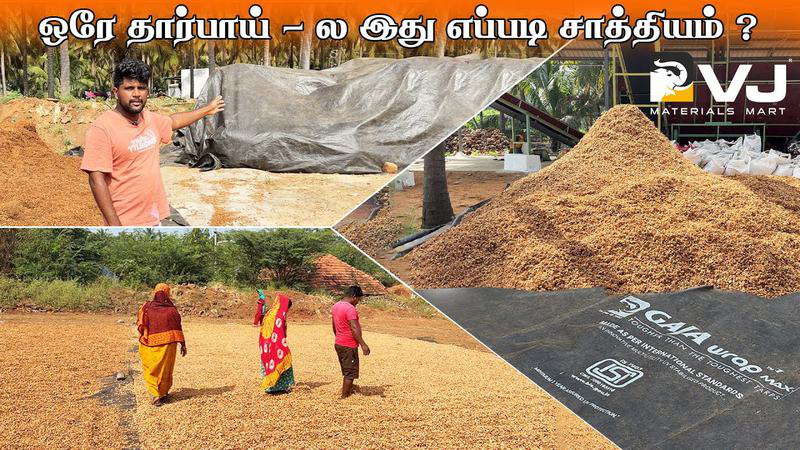

GSM is the weight of one square metre of tarpaulin fabric. Pick it from the job, not the price list: light sheets for short-term covering, mid-weight UV-stabilised sheets for a season outdoors, and heavy sheets for kilns, coir yards, poultry sheds and lorry loads that stay out permanently. Hems, eyelets and UV stabilisation matter as much as the number.
In this guide
What GSM actually measures
GSM stands for grams per square metre. It is the weight of one square metre of the fabric, and it is the closest single number you have to "how much material is in this sheet".
A higher GSM sheet has more polymer in the same area. That usually means thicker yarn, a tighter weave, or both — so it resists tearing, abrasion and UV for longer. It also costs more and is heavier to handle.
GSM is not the same as thickness in microns, and it is not a quality grade on its own. A well-made 150 GSM sheet from good raw material will outlast a poorly made 200 GSM sheet made from recycled scrap.
Ask three questions before you pick a number
- How long does it need to last? A cover you will replace every season and one you expect to keep for five years are not the same buy.
- Is it under constant sun? UV is what kills most tarpaulins. Continuous outdoor exposure needs a UV-stabilised sheet, not just a heavier one.
- How much handling will it take? A sheet that is folded, dragged and re-tied every day wears at the folds and eyelets long before the middle fails.
- What is underneath it? Sharp edges — brick stacks, timber, machinery corners — puncture from below no matter what the GSM is.
Rough guidance by use
Light, short-term covering — a grain heap for a few weeks, a temporary shade — does not need a heavy sheet. Buying up here mostly buys weight you have to lift.
Everyday farm covering that stays out through a season needs a mid-weight, UV-stabilised sheet with reinforced hems and properly set eyelets. The hems and eyelets matter as much as the GSM, because that is where sheets usually fail first.
Industrial covering — brick kilns, coir yards, poultry sheds, lorry loads — sits at the heavy end. These sheets stay out permanently, get walked on, and are re-tied constantly. Here the extra weight earns its money.
The parts of the spec people forget
- Hems. A double-folded, stitched hem is what stops a tear from running across the whole sheet.
- Eyelets. Spacing and reinforcement decide whether the sheet rips at the tie points in the first storm.
- UV stabilisation. Without it, the strongest weave still goes brittle and chalky.
- Size. A sheet cut to your actual span needs fewer joins and fewer tie points, and joins are weak spots.
Where we come in
We manufacture HDPE tarpaulins in-house at our Erode line, to any size, any GSM and any quantity. That means you do not have to fit your job to a standard sheet size — you tell us the span and the duty, and we make to that.
If you are not sure which grade fits your work, call us and describe the job. It is a two-minute conversation and it usually saves a wrong purchase.
Questions people ask
What does GSM mean on a tarpaulin?
GSM is grams per square metre — the weight of one square metre of the fabric. A higher GSM sheet has more material in the same area, so it usually resists tearing, abrasion and sun for longer, but it also costs more and is heavier to handle.
Is a higher GSM tarpaulin always better?
No. GSM is not a quality grade on its own. A well-made sheet from good raw material will outlast a heavier sheet made from recycled scrap, and for short-term covering a heavy sheet mostly adds weight you have to lift. Match the GSM to how long the sheet stays out and how much handling it gets.
Which tarpaulin GSM for a brick kiln, coir yard or lorry?
These are permanent, heavily handled covers, so they sit at the heavy end of the range with reinforced hems and properly set eyelets. Tell us the span and the duty and we make to that size and grade at our Erode line.